A balanced plate without scales or calories
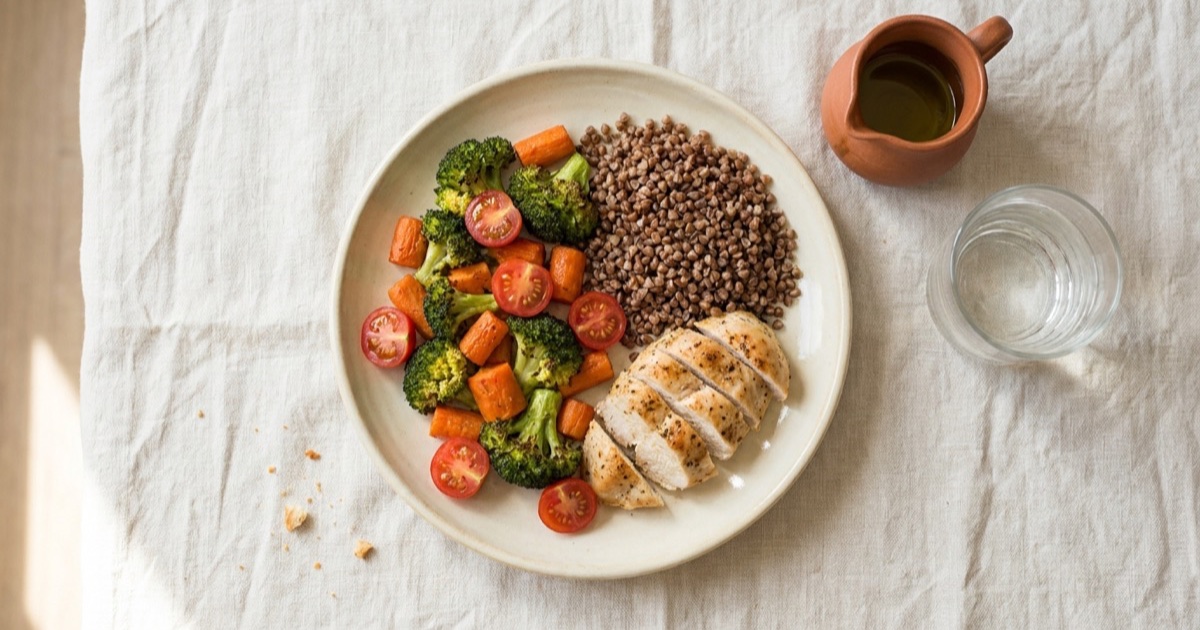
The healthy plate method from the Harvard T.H. Chan School of Public Health: how to build a complete meal by looking at the plate instead of a tracking app.
Why proportions beat numbers
Calorie counting works exactly as long as you keep doing it. Most people stop within two weeks — not out of laziness, but because weighing every breakfast is not compatible with ordinary life.
The healthy plate method sidesteps that: it describes parts of a plate rather than grams. You look at the plate and you can see whether it is balanced.
Half the plate: vegetables and fruit
The biggest share, and the one most often missing. The more colours, the wider the range of vitamins: green, red, orange.
Potatoes do not count here — in terms of blood sugar they behave more like a grain than a vegetable.
A quarter: whole grains
Buckwheat, brown rice, bulgur, quinoa, pearl barley, wholegrain bread, durum pasta. They keep you full longer because they are digested more slowly than white bread and white rice.
Swapping white for wholegrain changes more than it seems: the same dish holds off hunger for two or three hours longer.
A quarter: protein
Fish, poultry, eggs, legumes, cheese, tofu, nuts. Red meat less often; processed meats such as sausages and bacon are best avoided.
Legumes count as both protein and fibre — the cheapest way to make a plate complete.
Plus oil and water
A spoon of plant oil in the dressing is not the enemy; it is part of a balanced meal, because vitamins A, D, E and K are not absorbed without fat.
Drink water, tea or coffee without sugar. Sweet drinks are calories that provide no fullness at all.
What it looks like in practice
Dinner: half the plate is broccoli and carrots with oil, a quarter is buckwheat, a quarter is baked chicken breast. That is all — no counting.
Breakfast: porridge made with water (a quarter), Greek yoghurt (a quarter), a handful of berries and an apple (half), nuts on top.
If half the plate is not vegetables, the meal is not “bad”, it is simply unbalanced. The easiest fix is to add any vegetable you have at home.
In short
A healthy plate is neither a diet nor a restriction. It is a way to build an ordinary home-cooked meal so that it is complete — and to do it in a second, without touching a scale.